
Contents and tools
Preview. Before you start is open to everyone. Sign in with your bergson.ai account to read all seven chapters, use the Toolkit and keep your notes, free and with no tokens needed. No account yet? Choose Sign in and create one there. It is free and takes a minute.
Sign in to bergson.ai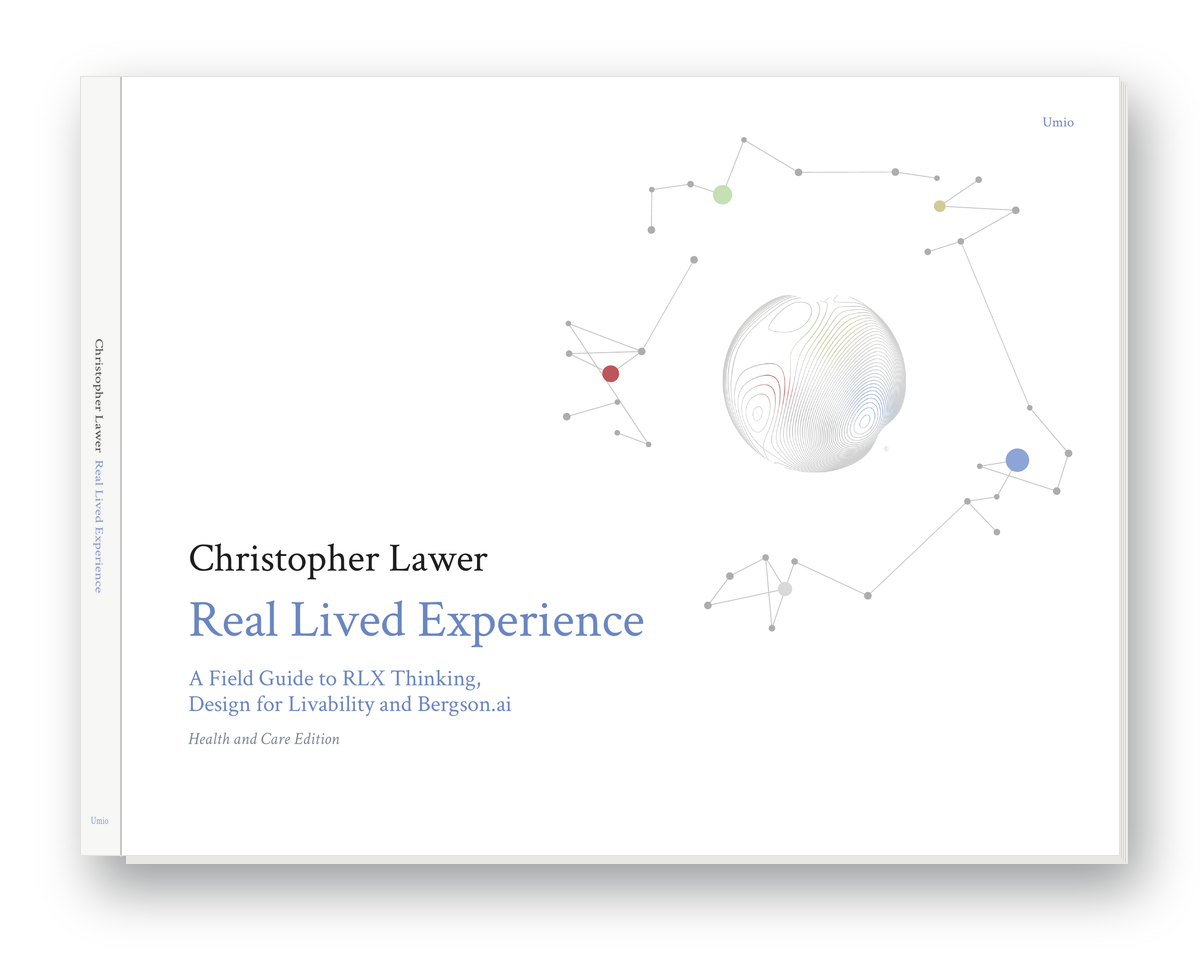
The paperback is available from 7 January 2027
What the Field Guide is
Health and care systems are built from the outside in: on needs, metrics, personas and pathways. They miss how life is lived, so even good ideas feel misaligned. The Field Guide shows how to begin from within experience instead, how to perceive it across three registers, how to design with the twelve Design for Livability® principles, and how to work towards livability: whether and how much life can proceed, safely, free of attention to a condition, with care available when needed.
It is written for anyone who designs, delivers, funds or governs something that touches people's lives. It keeps the health examples that shaped RLX, and carries each idea into education, work, housing, places and services in panels marked Beyond health.
The book. Real Lived Experience: A Field Guide to RLX Thinking, Design for Livability and Bergson.ai, Health and Care Edition by Chris Lawer is published by Umio Limited. The paperback is available from 7 January 2027 (ISBN 9798143790681). Nicki Sutton, his collaborator, contributed to the guide. The interactive version here holds the full text of the book.
Before you start
Open to everyone as a preview.
Part One
Why we need to get real
The crisis of perception, and what Real Lived Experience is.
We live in an age of extraordinary innovation. Yet for many people, life with a long-term condition, a difficult transition or a complex system feels strangely untouched by it.
Sign in to read this chapter.
RLX, with particular emphasis on the R for Real, is the always-unfolding, situated and affectively charged reality that people live through.
Sign in to read this chapter.
16 sections
- What is Real Lived Experience?
- A relational, emergent field
- What it means to perceive RLX
- Lives that metrics cannot hold
- Each field is singular
- The same reality in other systems
- Why prevailing thinking misses life
- The six features of the Blind Spot
- The surreptitious substitution
- Five fundamental shifts
- The shifts in practice
- Five ways Design with RLX differs
- Design with RLX compared with other approaches
- RLX repositions design
- Begin an inside-out field reading
- Chapter takeaways
Part Two
RLX value, perception and principles
Who benefits from RLX, how to perceive it across three registers, and twelve Design for Livability principles for working with it.
By reframing design, innovation and practice around actual, concrete, real lived experience, RLX creates value across the whole ecosystem.
Sign in to read this chapter.
12 sections
- Who experiences the value?
- Recognised as human beings, not cases
- A return to why people entered the work
- Innovation in rhythm with real life
- What RLX innovation can look like
- Innovation as deeper sensing
- Making care feel like care again
- Insurers, payers and commissioners
- Policy makers and public health bodies
- RLX value in other fields
- Summary benefits for each experiencer
- Chapter takeaways
Experience is not flat or singular. It unfolds across three registers, each with its own mode of expression, perceptual demands and implications for care and innovation.
Sign in to read this chapter.
Twelve orientations, ethical, perceptual and practical, that help us move with the grain of lived experience rather than against it.
Sign in to read this chapter.
19 sections
- Principles, not rules
- What problem does RLX address?
- The twelve Design for Livability principles
- How the principles fit together
- Principle 1: Perceive Experience in Its Emergence
- Principle 2: See the Experience in its Wider Relational Field
- Principle 3: Engage Intensity Before Identity
- Principle 4: Make the Virtual Perceptible
- Principle 5: Recognise Difference in Kind, Not Just Degree
- Principle 6: See Events and their Expressions in Duration
- Principle 7: Reveal Thresholds and Their Conditions
- Principle 8: Recognise Directionality, Not Just Intervention
- Principle 9: Attend to What Is Not Yet Legible
- Principle 10: Undo Limiting Tendencies
- Principle 11: Co-compose Within the Flow of Experience
- Principle 12: Design Across the More-Than-Human
- A grammar, not a method
- Ooex: a platform for real lived experience in motion
- Chapter takeaways
Part Three
From livability to action
Livability as the purpose of care, a final word, and simple actions you can begin today.
What, ultimately, are we trying to create through long-term condition care? Livability names that purpose: whether, and how much, a life can proceed.
Sign in to read this chapter.
13 sections
- Two kinds of time, two kinds of world
- Ruth: clinically stable, experientially contracting
- What is livability?
- What livability is not
- Livability shifts the question
- Six livability shifts
- What changes when livability is the purpose
- Eleven dimensions of the lived world
- The value of livability
- Making livability workable
- Attenuation: more connected, less responsive
- Run a livability reading
- Chapter takeaways
This guide is both an invitation and a provocation. Innovation and systems must get real.
Sign in to read this chapter.
Glossary and resources
Sign in to read this chapter.
How the interactive guide works
Chapter by chapter
Contents beside every page, a chapter overview, and next and previous at the foot of each section. It reads well on a phone.
The Toolkit
Every Try this, Ask, Watch for, Key term, Example, Field note, Beyond health and Benefits panel, gathered by type, each linked back to its page.
Your field journal
Write notes on any page, in the guide's own notes boxes or below each section. They are kept with your account, and gathered on one page.
Progress
Mark sections as read, see how far you are through each chapter, and continue from where you stopped.
Glossary and search
Key RLX terms in plain language, and search across the whole guide for an idea, a term or an exercise.
Getting access
Before you start is open to everyone. The rest is free to anyone with a bergson.ai account, with no tokens needed. Choose Sign in, create your account if you do not have one, and you come straight back.
Praise for Chris Lawer's previous work
“A much-needed paradigm shift in co-creating transformational change toward an enhanced state of our wellbeing. An outstanding, remarkable and masterful job.”
Professor Venkat Ramaswamy, Ross School of Business, University of Michigan
“Chris Lawer’s re-conception of value provides the breakthrough thinking that health systems need to repurpose resources and transform delivery systems.”
Professor Neal Halfon, UCLA Fielding School of Public Health
“I can see how it would extend and enhance my work in terms of clinical reasoning for advanced practice in nursing. The Umio framework is comprehensive and just what we need to help deal with the complexities of health care as we learn to value differences and activate capacities.”
Daniel Pesut, PhD, RN, FAAN, Emeritus Professor of Nursing, University of Minnesota
“Chris does not allow us to be sloppy or lazy. If we let him, he will guide us on a better path forward. His book and models are cutting edge and essential to thinking differently and well about healthcare.”
Peter Sorensen, Organisation Design Consultant, Adjunct Professor at SMU Lyle School of Engineering
Real Lived Experience: A Field Guide to RLX Thinking, Design for Livability and Bergson.ai, Health and Care Edition. Chris Lawer, with Nicki Sutton. Umio Limited, 2026. Paperback ISBN 9798143790681, from 7 January 2027. Copyright © 2026 Umio Limited. All rights reserved.