
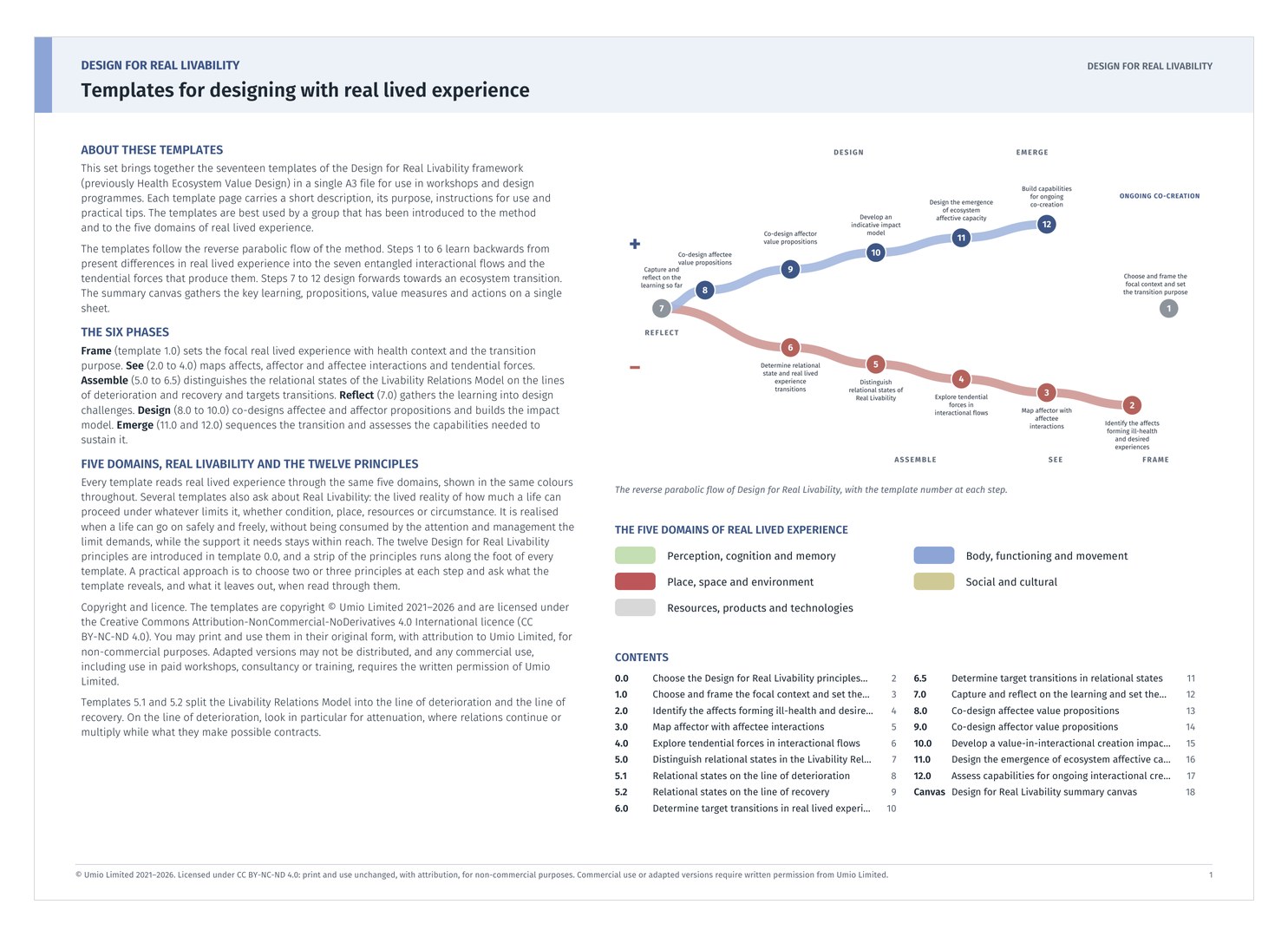
Resources now has a Templates section. Each template opens on its own, ready to print and use in workshops, programmes and everyday practice.
The Design for Real Livability framework templates run in the order they are used, from choosing principles and framing the focal context to designing how Real Livability can emerge and be sustained, with a summary canvas. Print them at A3.
- About the Design for Real Livability Templates
- Template 0.0: Choose the Design for Real Livability Principles to Carry Through the Programme
- Template 1.0: Choose and Frame the Focal Context and Set the Transition Purpose
- Template 2.0: Identify the Affects Forming Ill-Health and Desired (Valued) Experiences
- Template 3.0: Map Affector with Affectee Interactions
- Template 4.0: Explore Tendential Forces in Interactional Flows
- Template 5.0: Distinguish Relational States in the Livability Relations Model
- Template 5.1: Relational States on the Line of Deterioration
- Template 5.2: Relational States on the Line of Recovery
- Template 6.0: Determine Target Transitions in Real Lived Experience
- Template 6.5: Determine Target Transitions in Relational States
- Template 7.0: Capture and Reflect on the Learning and Set the Design Challenges
- Template 8.0: Co-design Affectee Value Propositions
- Template 9.0: Co-design Affector Value Propositions
- Template 10.0: Develop a Value-in-Interactional Creation Impact Model
- Template 11.0: Design the Emergence of Ecosystem Affective Capacity
- Template 12.0: Assess Capabilities for Ongoing Interactional Creation
- Design for Real Livability Summary Canvas
The Real Livability Practice charts come from the Practical Guides, for use with people and in teams.
- Field Questions by Domain
- Field Reading Template
- A Field Reading, Worked Through
- Neighbourhood Field Map
- A Neighbourhood Case Review, Worked Through
Resources are free to read when you sign in.